
Description
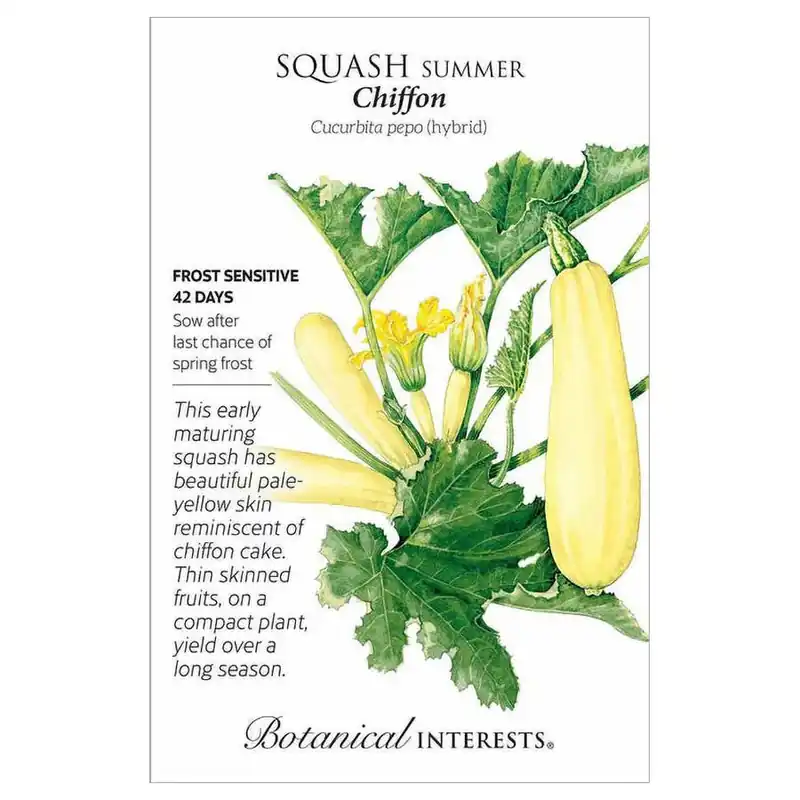
“Chiffon” boasts all the qualities of a perfect summer squash. With high yields, it will produce nearly all summer, starting earlier than most varieties. Fruits grow on upright, compact bushes approximately 2′ tall and 3-4′ wide with moderate resistance to powdery mildew. The creamy-yellow skin is very delicate, lending to excellent flavor and texture. Summer squash can be picked extra small giving your dishes a high-class flare or picked at a more mature stage between 6-8″ long.
Variety
6″-8″ long, cylindrical fruits with pale-yellow skin and creamy white interior. “Chiffon” plants have moderate tolerance to powdery mildew.
Days to Maturity: 42 days
Family: Cucurbitaceae
Type: Bush Squash, Summer Squash
Native: North America
Hardiness: Frost-Sensitive Annual
Exposure: Full Sun
Plant Dimensions: Compact Vines form a 2′ Tall by 3′-4′ Bush Type Plant
Attributes: Frost Sensitive
Sowing
When to Sow Outside
Recommended. 1 to 2 weeks after your average last frost date and when soil temperature is 70°-85°F.
When to Start Inside
Not recommended except in very short growing seasons, 2 to 4 weeks before transplanting. Roots are sensitive to disturbance; sow in biodegradable pots that can be planted directly into the ground. Transplant when soil temperature is at least 60°F.
Days to Emerge: 5-10 Days
Seed Depth: 1/2″-1″
Seed Spacing: 3 Seeds Per Mound
Row Spacing: 3′-4′
Thinning: When 3 leaves, Thin to 1 Plant Per Mound
Growing
Harvesting
Harvest frequently to increase yield; squash seem to get monstrous overnight. While edible at any size, seeds are less developed in young fruit, therefore more tender. Using a knife or clippers, cut squash off including some of the stem. By including stem, the fruit is sealed and less likely to mold or dry out. Harvesting Blossoms: Look for male, non-fruit producing flowers that have long stems and harvest just before use (female flowers have a swollen mini-squash at the base of the flower and shorter stems).
Special Care
Floating row covers can help protect from squash vine borer and cucumber beetles. Remove covers when plants begin flowering. Another method to exclude vine borers is to cover the base of the stems near the ground with mulch, foil or fabric material as the base of the stem is where insect eggs are laid. Squash plants are susceptible to fungal disease, so make sure plants have ample space for air circulation. Sowing pollinator-attracting plants near squash can assist in proper pollination, resulting in a bigger harvest and well-shaped fruit.
Specifications
Type: Conventional

Reviews
There are no reviews yet.